
Home Colon Cancer Tests – Stool Tests Compared
With a home colon cancer test, you take your stool sample yourself – discreetly, without a doctor's appointment and without any special preparation. You send the sample free of charge to our physician-supervised laboratory in Germany. You receive your result 5–7 days after the sample arrives at the laboratory.
Our stool tests at a glance
We offer two stool tests: the ColoAlert® stool test, which checks for tumour DNA as well as hidden blood, and the classic faecal immunochemical test (FIT). Here you can find out how the tests differ, who they are suitable for and what happens after the result.
-
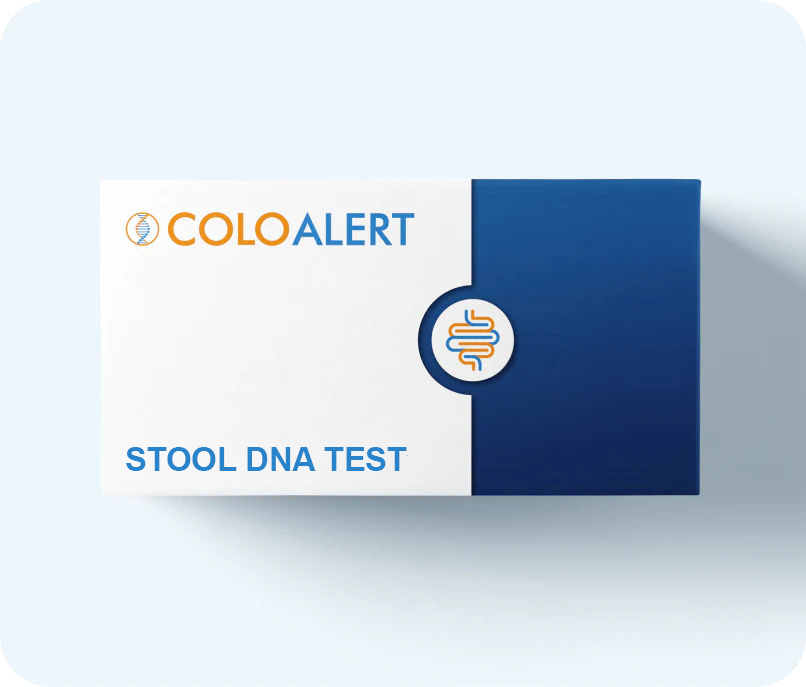
ColoAlert® Stool Test
Order ColoAlert
Stool test with tumour DNA analysis: checks for hidden blood in the stool and also for tumour DNA (KRAS and BRAF mutations, total amount of human DNA).
Detection rate: approx. 85 %¹
Reimbursable for privately insured patients in Germany (GOÄ invoice)Price: €257.98
-
FIT (Faecal Immunochemical Test)
Order FIT
The proven standard test for hidden blood in the stool. Because polyps and colon cancer often do not bleed in early stages, the detection rate is limited.
Detection rate: approx. 62 %²Price: €44.89
How the home colon cancer test works
-

Order online
The test kit is delivered discreetly to your home.
-

Take the sample
Done in a few minutes with the enclosed kit – no diet or special preparation. Detailed instructions and a video help you.
-

Send it back free of charge
The sample is sent to our laboratory in Germany at no shipping cost.
-

Receive your result
A few days after the sample arrives at the laboratory – delivered quickly and securely.
ColoAlert®, FIT and Colonoscopy Compared
| Method | Detection rate | How it is done | What is analysed? | Advantages | Limitations |
|---|---|---|---|---|---|
| ColoAlert® (tumour DNA + blood) | approx. 85 %¹ | Sample at home, analysis in the laboratory | Hidden blood and tumour DNA | Also detects DNA changes, no preparation, reimbursable via German private health insurance | Higher price, self-pay for patients with German statutory insurance |
| FIT (blood in stool) | approx. 62 %² | Sample at home, analysis in the laboratory | Hidden blood | Inexpensive, proven, covered by German statutory insurance from 50 via a doctor's practice | Only detects changes that bleed |
| Colonoscopy | Gold standard | At a doctor's practice, with bowel preparation | Direct view of the bowel lining | Polyps can be removed directly, covered by German statutory insurance from 50 | More effort: appointment, laxatives, usually sedation |

¹ Dollinger et al. 2018; Krammes et al. 2025. ² Gies et al. 2018.
Who is a home colon cancer test suitable for?
A home stool test is intended for people without symptoms who want to get screened – for example, if a colonoscopy is not an option for you right now or if you want to test between two screening examinations.
Screening before the age of 50: In Germany, statutory health insurance covers colon cancer screening from the age of 50. ColoAlert® is intended for people aged 45 and over. Between 45 and 50, you can use the test as a self-payer.
ColoAlert® is not suitable for people with irritable bowel syndrome, chronic inflammatory bowel disease (ulcerative colitis, Crohn's disease), familial adenomatous polyposis (FAP) or hereditary non-polyposis colorectal cancer (HNPCC). In these cases, please talk to your doctor.
If you have symptoms, see a doctor first: Do you have blood in your stool, changed bowel habits, persistent abdominal pain or unintended weight loss? Or has a close family member had colon cancer? Then the investigation belongs in a doctor's hands.
What to look for in a home colon cancer test
-
What is analysed?
Most stool tests only check for hidden blood. ColoAlert® also analyses tumour DNA.
-
Who analyses the sample?
With rapid tests, you read the result yourself from a test strip. With our tests, a physician-supervised laboratory in Germany does this. Your health data is processed in line with European data protection standards.
-
What happens after the result?
An abnormal result is not a diagnosis, but it should be investigated by a doctor – usually with a colonoscopy.
-
What does the test cost, and who pays?
ColoAlert® costs €257.98 and is reimbursable for patients with German private health insurance. The FIT costs €44.89. Shipping and return shipping are free within Germany.
You can read more about the differences between the test methods in our guide Which stool test is best?
"By detecting tumour DNA, ColoAlert effectively closes the analytical gap between colonoscopy and other stool tests."
Prof. Dr. Dr. Matthias Dollinger
Chief Physician and Coordinator
Colorectal Cancer Centre, Klinikum Landshut
(Quote translated from German)

Let customers speak for us
from 165 reviewsEin perfekt organisiertes, einfaches Verfahren zur schnellen Durchführung eines Stuhltests. Verständliches Diagnosedokument mit Hinweis auf Risiken und Maßnahmen bei einer möglichen Fehldiagnose. Aus meiner Sicht ein sehr angenehmer Ersatz für die extrem unangenehme Vorbereitung einer Koloskopie.
Entgegen der herkömmlichen Methode der Darmuntersuchung ist Colo Alert einfach auszuführen. Ich muss nichts vorher einnehmen oder mich sonst einschränken. Ich finde es großartig, diese Mõglichkeit zu haben
sehr guter Test,Coloskopie veranlasst
Das Produkt und der Prozess haben mich überzeugt. Nach dem Befund noch unkompliziert und selbstverständlicherweise noch Rückfragen stellen zu dürfen war ebenfalls sehr wertvoll.
Klappt alles professionell, meine erste Probe war nicht aussagekräftig, prompt bekomme ich, ohne Zusatzkosten eine zweite Möglichkeit.
Die Rückmeldungen über mail sind zeitnah und detailliert.
Insgesamt eine runde, empfehlenswerte Aktion.
Wer eine Alternative zur Coloskopie als Darmkrebs-Prophylaxe sucht, rate ich zum ColoAlert-Test. Neben dem iFOBT erfährt man, ob im Darm OncoGene nachgewiesen werden können, die bei einer Carcinom-Entwickung ein aggressives Wachstum voraus sagen. Der Test ist so einfach wie der iFOBT alleine und wird nur zu Hause vorgenommen. - Die Kommunikation mit dem European Oncology Lab - Team kann ich nur als hervorragend bewerten!
Frequently asked questions about home colon cancer tests
How reliable is a home colon cancer test?
That depends on what the test analyses. Classic faecal immunochemical tests (FIT) detect around 62 % of colon cancer cases, the ColoAlert® stool test with additional tumour DNA analysis around 85 %. No stool test detects every case. Colonoscopy remains the gold standard for colon cancer screening.
How much does a home colon cancer test cost?
The ColoAlert® stool test costs €257.98, the FIT €44.89. Shipping and return shipping within Germany are free, and the laboratory analysis is included in the price.
Does health insurance pay for the stool test?
Patients with German private health insurance receive a GOÄ invoice for ColoAlert® that they can submit to their insurer. For patients with German statutory insurance, a stool test ordered online is a self-pay service. From the age of 50, statutory health insurance covers a FIT every two years if you obtain it through a doctor's practice. If you have symptoms or a family history, it also covers a medical investigation earlier.
From what age does a stool test make sense?
Statutory colon cancer screening in Germany starts at 50. ColoAlert® is intended for people aged 45 and over and can be used as a self-pay service before the age of 50. If you have symptoms or if colon cancer runs in your close family, please talk to your doctor first.
How is the sample taken?
You don't need any special preparation and can eat and drink as usual. With the enclosed kit, you take the stool sample in a few minutes and send it to our laboratory free of charge within Germany. Detailed instructions are included in every kit, and there is also a video guide.
When will I receive my result?
You receive your result 5–7 days after the sample arrives at our physician-supervised laboratory in Germany.
What happens if the result is abnormal?
An abnormal result is not a diagnosis. It shows that a medical investigation is advisable, usually by colonoscopy. Often there is a benign cause, for example haemorrhoids or a polyp that can be removed directly during the colonoscopy.
How is this different from a rapid test from a pharmacy or drugstore?
With rapid tests, you read the result yourself from a test strip, and they usually only check for hidden blood in the stool. With our tests, a physician-supervised laboratory analyses the sample. ColoAlert® also analyses tumour DNA in addition to blood.
Medically reviewed
Dr. med. Annette Buhlmann
Specialist in Laboratory Medicine
With over 20 years of experience managing medical diagnostic laboratories, Dr. Annette Buhlmann brings extensive knowledge of human genetics, molecular genetics and general medicine.
Medically reviewed on 28 September 2026.